Meet the NI Ettus USRP B310
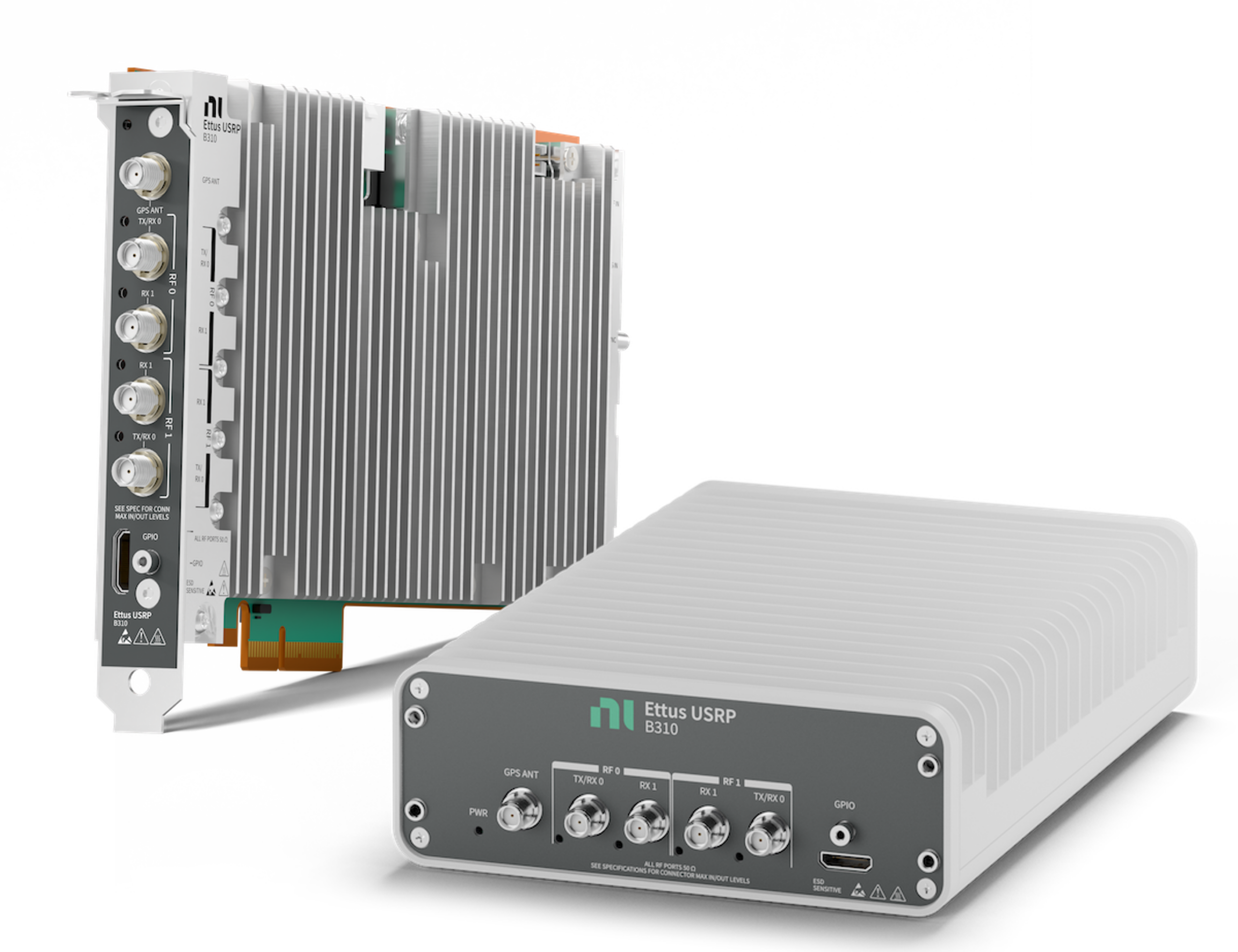
The Next Generation Entry-Level USRP
Today, we’re excited to introduce the NI Ettus USRP B310, a powerful new software defined radio designed to help researchers, educators, and developers accelerate innovation in wireless communications, signal intelligence, and AI-enabled RF systems.
Key USRP B310 features:
- 350 MHz to 7.2 GHz frequency range
- Up to 100 MHz instantaneous bandwidth per channel
- 2 transmit and 2 receive channels
- Independent local oscillators (LOs) for flexible tuning
- PCIe and Thunderbolt™ 3 connectivity options
- Multi-device synchronization without external clocking hardware
- Supported in UHD and RFNoC
The B310 is available as a PCIe plug-in card, an enclosed Thunderbolt desktop module, or a shielded OEM board. You can integrate it directly into embedded systems, pair it with GPU platforms, or use it as a stand-alone lab instrument.
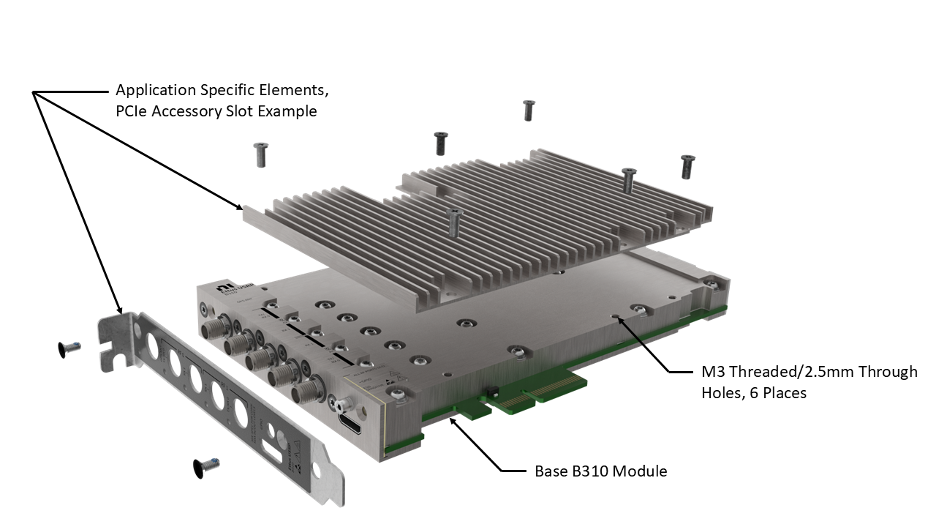
Whether you’re building a prototype for advanced wireless research, developing AI-driven RF applications, or deploying distributed sensing systems, the B310 provides a highly capable platform that scales with your ambitions.
Built for the AI Era
As RF applications increasingly rely on machine learning and real-time signal processing, moving data efficiently between the SDR and GPU becomes critical.
The USRP B310 addresses this challenge with PCIe-based connectivity, enabling low-latency, high-throughput streaming directly to GPU-equipped systems such as NVIDIA® Jetson™ platforms. This architecture minimizes bottlenecks and simplifies the deployment of AI-enabled wireless applications, including:
- Spectrum sensing
- Signal classification
- Electromagnetic spectrum operations (EMSO) research
- Cognitive radio
- Automated interference detection
- 6G, AI-RAN, and advanced wireless communications
Simplifying MIMO and Distributed Systems
The B310 supports 3 methods of synchronization—GPS time-based sync, 10 MHz and PPS (with a CDA-2990 accessory), and a new innovative feature called multi-device synchronization. Multi-device sync can synchronize up to four devices using a single specialized cable. This enables the creation of 8×8 MIMO systems with accurate phase alignment and timing coherence while reducing system complexity and cost. Below is a table of the relative phase stability and repeatability achieved for different types of sync with the B310.
| Configuration | Measurement | Result |
| Single device (sharing internal LOs) | Phase Stability | < 0.08° RMS |
| Single device (sharing internal LOs) | Phase Repeatability | < 0.3° RMS |
| Multi-device (USRP sync cable) | Phase Stability | < 1° RMS |
| Multi-device (USRP sync cable) | Phase Repeatability (Power Cycle) | < 2° RMS |
| Multi-device (CDA-2990) | Phase Stability | < 3° RMS |
| Multi-device (CDA-2990) | Phase Repeatability (Power Cycle) | < 10° RMS |
Researchers can build scalable distributed radio systems with greater confidence in synchronization performance and significantly less setup overhead. These sync features are particularly valuable for applications like:
- Beamforming research
- MIMO experimentation
- Direction finding
- Spectrum monitoring
- Counter-UAS and sensing applications
A New Foundation for Next-Generation Wireless Innovation
Wireless technology is entering a new era where AI, distributed sensing, and advanced communications are converging. The USRP B310 was designed specifically for this transition, combining modern connectivity, powerful RF performance, and scalable synchronization capabilities in a compact, accessible platform.
Whether you’re teaching the next generation of wireless engineers, developing cutting-edge AI algorithms for RF environments, or prototyping the next breakthrough in communications technology, the USRP B310 provides the performance and flexibility to accelerate your work.
We look forward to seeing what the wireless community builds next with the USRP B310.